

Two generations under one sermon: how Tucson Young Nak Church serves first- and second-generation Koreans
Deacon Hangil Paul on the once-a-month multi-generational service that brings first- and second-generation Koreans together at Tucson Young Nak Church — and the Korean church terminology that tripped up other translation tools.
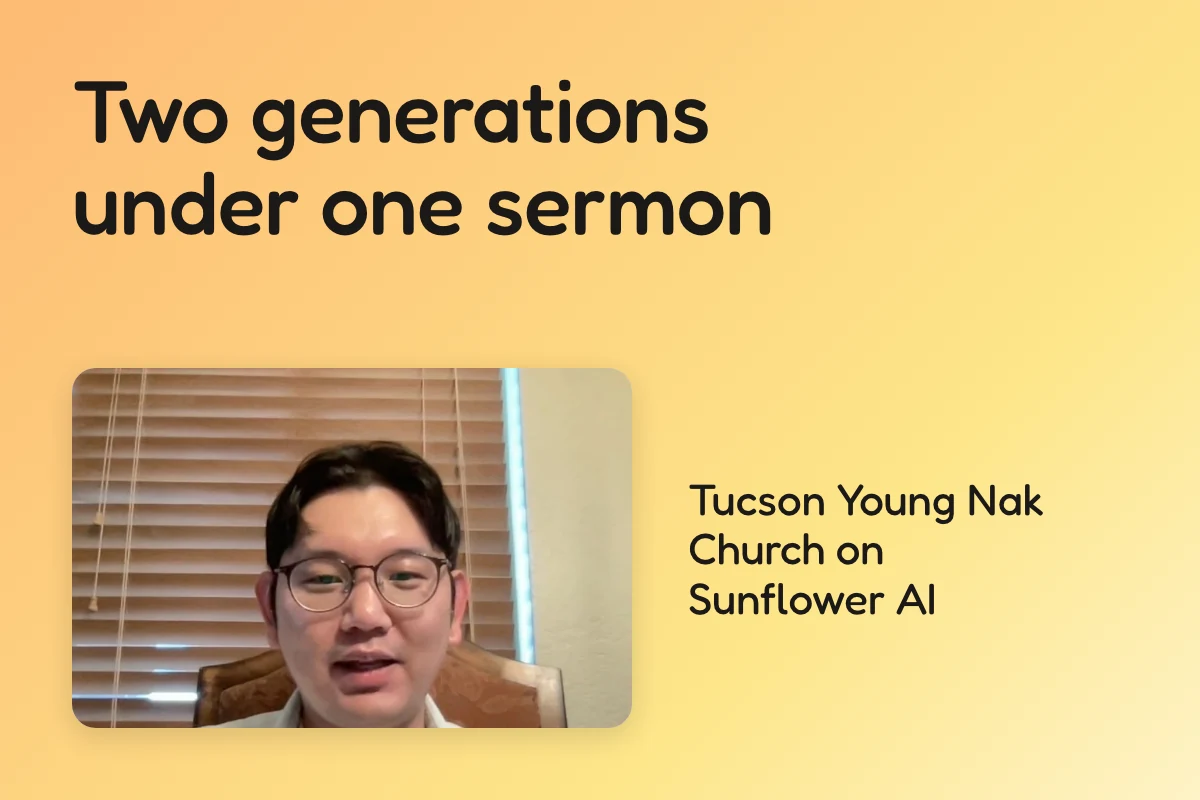
Tucson Young Nak Church is a Korean-speaking congregation in Tucson, Arizona. Sunday worship runs in Korean for the adults; a Sunday school and youth ministry run in English for the kids who have grown up in Tucson. Once a month, the two halves of the church gather for a single combined service — still in Korean — and that is where Sunflower AI comes in.
Hangil, who also goes by Paul, is a Deacon at the church and the treasurer of its Young Adults ministry. He recorded a short testimony about the multi-generational service, and about what getting the translation right means for keeping two generations of Korean Americans inside the same Sunday gathering:
Why the multi-generational service exists
Hangil’s framing starts with a problem that has had a name in the American Korean church world for thirty years: the children of immigrant believers tend to drift away from their parents’ congregations once they leave home. Tucson Young Nak’s once-a-month combined service is the church’s small-scale answer — a deliberate attempt to give kids the rhythm of a Korean-language gathering before they’re old enough to find their own.
We wanted our younger generation to have a similar experience to what they’re going to be used to when they grow up and go to a Korean church. It was not an easy transition to go from growing up in a Korean church straight into an American church when they went to college, and it ends up not working out for them — and they end up leaving the church.
Most Korean churches in the United States handle the language split by running two parallel services: a Korean-language service for the parents and an English-language service for the kids. Tucson Young Nak runs that pattern for three Sundays a month. On the fourth, it runs ONE Single Service with Korean-to-English live translation subtitle on the screen.
The Korean church-terminology problem
Before Sunflower AI, the team experimented with the obvious solutions and ran out of road quickly:
We tried different things, like manual translation — one of our church members doing translation through audio. It was not as good as we hoped it would be.
A live human translator is a beautiful thing on a good week. The realities of single-translator volunteering — the same person, every Sunday, week after week — tend to wear it out. From there, the team looked at general-purpose AI subtitle tools and ran into the specific problem that makes Korean church translation harder than the simpler European pairs:
Everyone who could understand both languages thought the translation level was almost perfect. There’s particular church terminology in Korean that is not easily translatable into English — which we found to be a problem for other translation services. But Sunflower has been really good for that.
Korean christianity vocabulary is a real stress test for general-purpose translation. Words a Korean pastor uses every Sunday — eunhye (grace), seongnyeong (Holy Spirit), guwon (salvation) — carry plain everyday meanings outside church speech too, and a model that doesn’t know it’s listening to a sermon often defaults to the everyday gloss. Sunflower AI accepts a sermon-preload before the service — a script, notes, or just the day’s Bible passages, pasted into the captions panel — and the transcription engine uses that text to lock onto the theological vocabulary, proper nouns, and biblical references that a general model would otherwise miss.
A shared sermon, a shared conversation
Because we have this multi-generational service, we are able to connect different groups together. Parents, when they go to church, want to share the experience of church and Christianity together with their kids. But before, because we had multiple services, it was not as easy. Now that we have a single service that we’re able to share between the different generations, they can go after church when they’re driving home and discuss the sermon. I think it helps connect the different generations together better.
Two separate Sunday services — one in Korean for the parents and one in English for the kids — can fund themselves operationally, but they don’t produce a shared object of conversation. Nobody has heard the same sermon. A single bilingual service produces, by definition, one sermon: whether the parents heard it in Korean and the kids read it in English, both groups are working from the same text by Sunday lunchtime.
We have a lot of first-generation Koreans that come to our church. As a second-generation myself, it’s sometimes hard to connect with our parents in a way — their experience in Korea and how they grew up is a lot different from how we grew up. Having this time where we can talk to each other about different things is very important.
The silent exodus
The drift Hangil describes has a thirty-year history of its own. Helen Lee’s 1996 Christianity Today cover story coined “silent exodus” for the pattern of younger Asian American believers leaving their parents’ immigrant churches as they came of age. The article cited studies that found 80 percent of second-generation Korean Americans hoped to attend a church where English was the primary language, and that the bulk of them did indeed leave their parents’ churches — often, eventually, leaving the faith too.
A monthly combined service connects the parents and the children to hear the same sermon together and have something to talk about on the drive home. For a church the size of Tucson Young Nak, that is a meaningful thing to offer.
What we hope for from here
If you are a pastor in a Korean American church — or in any heritage-language church where the second generation is growing up in English — and you are trying to build a service that holds both halves of the room, we’d love to talk.