

Following along in Urdu at Lakemba Anglican Church
A church member describes how Sunflower AI’s live Urdu translation lets his mother — who speaks no English — understand the service and read along on her phone, in one of Australia’s most linguistically diverse suburbs.
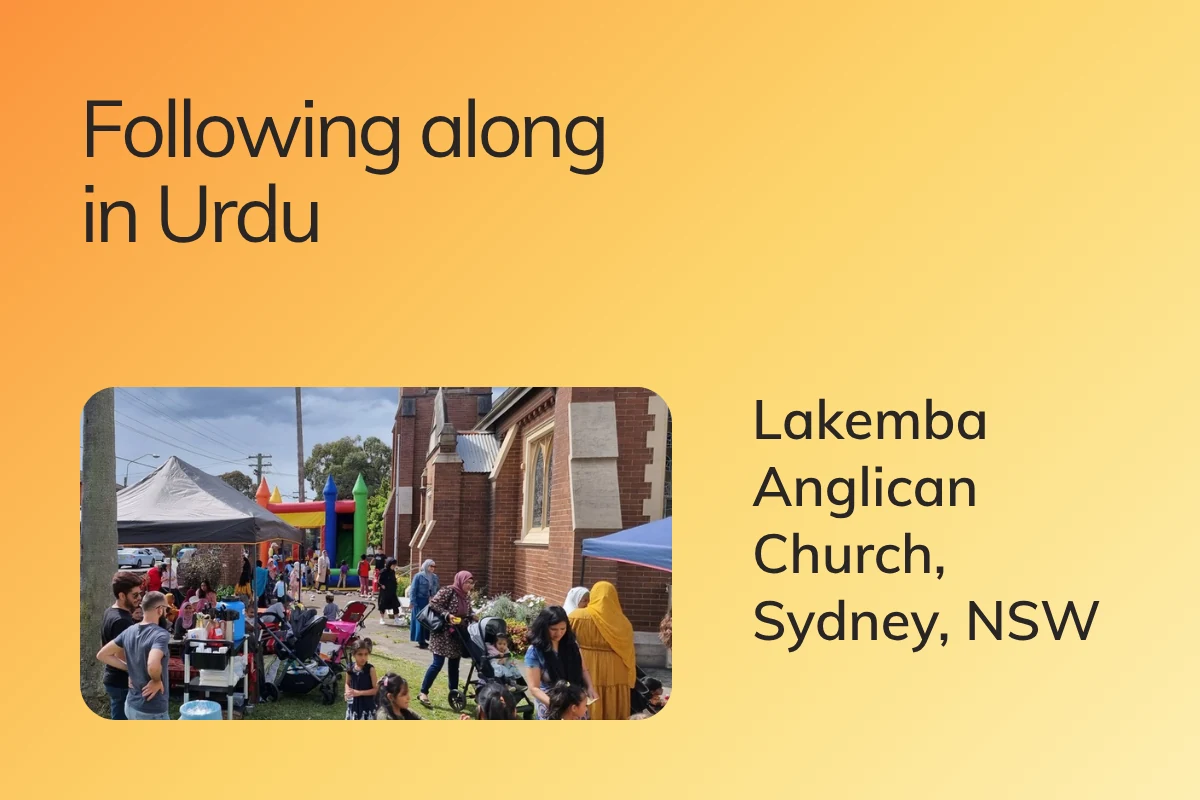
Lakemba, in Sydney’s south-west, is one of the most linguistically diverse suburbs in Australia. At the 2021 census, 73% of its residents spoke a language other than English at home, with Bengali, Urdu and Arabic among the most common. For Lakemba Anglican Church, that diversity shapes a practical question every Sunday: how do you make a service something the whole family can follow when not everyone in the family speaks English?
For one member of the church, the answer has been live Urdu translation. His mother speaks no English, which for a long time meant sitting through a service she couldn’t follow. In the video below, he explains what changed.
Following the service in Urdu
With Sunflower AI, the spoken service is captioned and translated in real time, and each person reads it on their own phone in the language they choose. For this family, that language is Urdu.
My mum does not understand and she does not speak English, and Sunflower is fairly helpful for her. So she can understand — especially the Urdu translation — she can understand in a better way.
The detail he returns to is that his mother no longer has to choose between reading and listening:
She can listen and read too, from her mobile phone.
That choice matters more than it might sound. A reader can follow the translated captions as they scroll, or listen to a spoken Urdu rendering through earphones, or move between the two — whatever keeps them in step with what’s happening at the front.
Urdu in Lakemba, and across Australia
Lakemba is the kind of place where a single language never tells the whole story. According to the City of Canterbury Bankstown community profile, Bengali is the most common language other than English spoken at home in the suburb (around 18.5% of residents), followed by Urdu (around 13.2%) and Arabic (around 10.5%). More than one in eight people in Lakemba speaks Urdu at home.
Urdu is also one of Australia’s fastest-growing languages. The 2021 census counted 111,873 Urdu speakers nationally, up more than 60% on the previous census and now the country’s 14th-largest language, concentrated in New South Wales and Victoria. For a church in the middle of that growth, an English-only service quietly leaves a large part of the neighbourhood on the outside.
Two languages, one service
There’s nothing elaborate about what happens here. A mother who speaks no English and a son who does can sit together on a Sunday and follow the same service — one in Urdu on her phone, one in English from the front — and talk about it afterwards.
If your church gathers people who don’t all share a language, we’d love to hear from you.