

One tablet, three communities: how Islington Baptist Church serves Chinese, Iranian, and Filipino members in one English service
Lead Pastor Matt Kennedy on how Islington Baptist Church in Newcastle moved from volunteer radio translators to a one-tablet Mandarin audio setup — and why one shared English service is the goal.
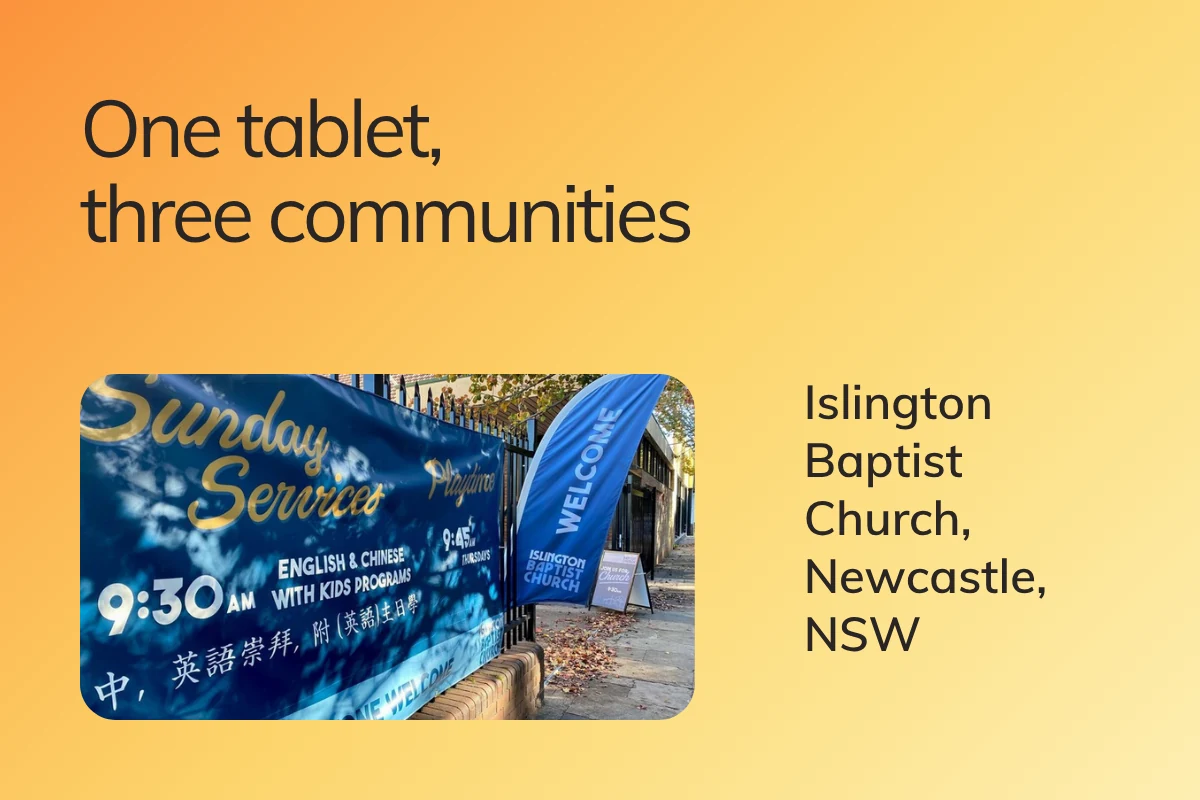
When Matt Kennedy first reached out about Sunflower AI, we hadn’t built the live audio feature yet. He’d email me a Bible study or a members’ meeting handout, our team would translate the document into Chinese, and we’d email it back the same day. Islington Baptist Church, where Matt is Lead Pastor, sits a few kilometres from the Newcastle CBD, in a part of New South Wales where about one in ten residents speaks a language other than English at home — and where Mandarin is comfortably the largest of those languages. Matt’s congregation has a long history of Chinese ministry, and he was looking for a way to fold that ministry into the main English service on a Sunday morning, rather than running it as a parallel track.
Just over a year on, that’s where Islington has ended up. Matt sat down recently and recorded a short testimony about how the church has settled into the rhythm:
From volunteer-led radio to one tablet at the desk
Before Sunflower AI, Islington was doing the work the way most multilingual churches in Australia still do it — by hand:
We were doing different things, trying to translate sermons — we were often doing that by individual volunteers translating and then speaking through a radio system. It was very labour-intensive, and wasn’t something we could do all the time, and put certain pressures on me as well.
A live human translator behind a glass partition is a beautiful thing when you can sustain it. Sustaining it Sunday after Sunday — and across members’ meetings, evangelistic courses, and mid-week gatherings — is the hard part. Volunteers get sick. Volunteers travel. And volunteers, eventually, get tired of being the only person who can do the job.
Matt started piloting Sunflower AI’s live translation at the start of 2025. The first improvement was straightforward: the text captions worked well enough out of the box that the native Mandarin speakers on his team — the same people who’d been doing the manual translation — signed off on the quality.
We started using Sunflower, and it just worked really well straight away. We have native Chinese speakers, Mandarin speakers, who were helping with the translation, who were really impressed with the quality of the translation. It just made everything so much easier.
Adding audio for older readers
There was still a gap — and it’s a gap that comes up at almost every church we talk to. Some readers can’t or won’t follow text on a phone. For some it’s eyesight; for some it’s reading habit; for some it’s just that staring at a phone during worship feels wrong:
We were trialling [Sunflower] early on, and one of the things we realised we still needed was an audio option, because we had some older Chinese folk who just didn’t read a lot, and certainly following on the phone wasn’t a great option for them personally.
That conversation is what pushed us to build live audio translation. In the early prototypes I almost felt like I should secretly speak behind the scenes just to make the demo sound AI-generated. We got the natural Mandarin voice working soon after — Matt says Sunflower “came to the party very quickly” on the audio feature.
The setup at Islington is small enough to live on a single trolley:
We just have one tablet running the translation plugged into a little radio transmitter. We use the same little digital receivers and headphones that we pass out to a number of people on a Sunday morning, and they can listen along. And we can use that for our Sunday gatherings, our members’ meetings, special evangelistic courses — yeah, we can use it all the time.
One tablet. One transmitter. The same headsets Islington already owned. No volunteer in a translation booth — and, crucially, no upper limit on which gatherings the church can offer the translation in.
Beyond Mandarin: Iranians, Filipinos, and one shared service
The bit of Matt’s testimony that surprised us most is about the languages Islington didn’t set out to support. Once the captions were running for Mandarin, the church started serving other communities in the room with the same setup:
Being able to also select multiple different languages — we were no longer just providing translation in Chinese, but we had Iranians, people from the Philippines, people from different countries. We could cater to more people, and that really helped us pursue a vision of welcoming people from all different cultural backgrounds.
This is the integration argument in a single sentence. The alternative model — a Mandarin service at one time, an English service at another — is workable, but it makes the church into a federation of language groups that gather separately and meet rarely. The model Matt is describing is the opposite: one service, in English, with everyone in the room reading or hearing it in their own language. The Chinese ministry doesn’t shrink; it sits inside the main gathering, with the rest of the church.
Why this matters in Newcastle
According to the City of Newcastle’s community profile, 10.5% of residents speak a language other than English at home, and Mandarin is the dominant such language — around 1,673 people, or 1.0% of the local population. After Mandarin come Cantonese, Spanish, Korean, and a long tail of others, none of them numerous enough on their own to support a standalone congregation in any given suburb.
For a parish-style church in Newcastle, that’s the maths Matt is solving for. When the Mandarin-speaking community in your suburb numbers in the hundreds, a separate Mandarin congregation is hard to sustain. Making the one English service you already run intelligible in Mandarin is more realistic.
Document translation: the loop closes
The other feature Matt called out is the one we built first — the document translation that started this whole relationship:
I also love having the document translation feature. That was, again, something that I was initially just emailing documents to Chuhao — “can you translate this for us?” Now it’s just at the click of a button. I can translate Bible study. Every week I write a Bible study for church and it gets translated into Chinese, and members’ meetings communication. Yeah, it’s just been super valuable for us.
The work we used to do for Matt by hand, our system now does in seconds. That’s both very satisfying and a little funny to look back on. In a startup, the hard thing is to decide what to build — and our earliest customers, Matt very much among them, are the reason we knew what to build next.
What we hope for from here
We’ve often said that we look forward to a day when millions of people are listening to a sermon in their heart language each week. Islington Baptist Church is one of the early signs that that day is coming — one tablet, one transmitter, one Sunday service at a time.
If you’re a pastor or AV lead in Newcastle, or in any town where the new languages on your street outnumber the seats in any one congregation, we’d love to talk.