

Learning English from the sermon: Sunflower AI at Grace Bible Church Holland Park
Planting Pastor Craig Lloyd on how Sunflower AI is serving the mixed-language households at his Brisbane congregation — and how one Colombian member is learning English from the Sunday sermon.
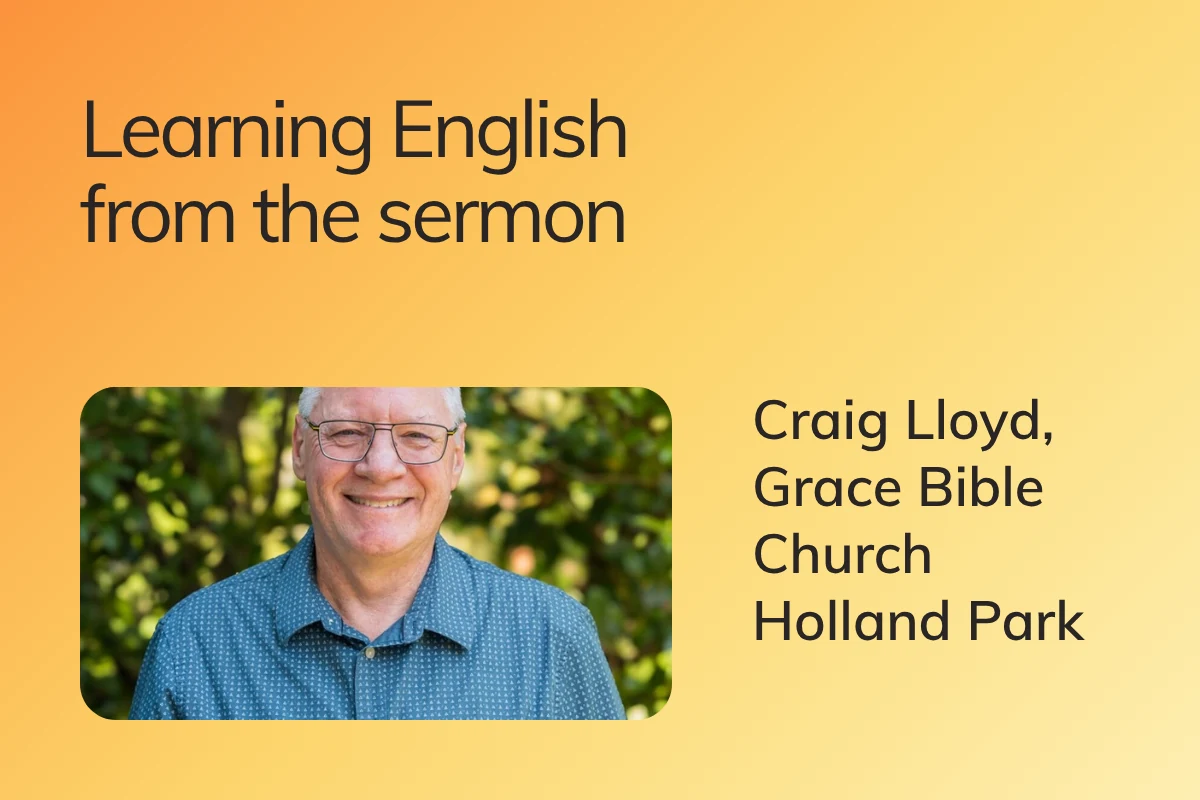
Our CEO Chuhao Liu is on the New South Wales Central Coast this week for Reach Australia’s national conference, and among the church leaders he sat down with yesterday was Craig Lloyd, Planting Pastor at Grace Bible Church Holland Park in Brisbane. Craig recorded a short testimony about what Sunflower AI has been doing for his congregation over the past year:
What stood out about Craig’s testimony isn’t the size of any one language group at Grace Bible Church Holland Park — it’s the shape of the households the church is serving.
A church for mixed-language households
Craig didn’t describe the congregation as “the Mandarin-speaking community at Grace Bible Church” or “the Spanish-speaking community”. He described something subtler:
We have a number of people that are either children of people whose English is not their first language, or married to somebody whose English is not their first language, and they’ve been able to worship together in the church and understand the sermon, the messages — everything — because of Sunflower.
These are members for whom a parallel-language service was never going to be the answer. The Colombian-born wife of a long-resident husband isn’t going to attend a Spanish-only congregation on a Sunday morning if her husband attends the English one; the adult child of immigrant parents wants to sit beside their parents in the same room, not in separate ones. The unit of belonging is the household. And the household speaks more than one language.
Sunflower AI’s live translation runs from the church’s existing audio feed and delivers real-time captions and audio in 83 languages. Members open the room on their phone, pick their language, and read or listen along in the same service as everyone else — no headsets to issue, no volunteer translator in a back room. For Craig’s setup, that meant a year’s worth of Sunday mornings in which mixed-language households could share one service.
We began using Sunflower about a year ago, and it’s been tremendous. We have a number of people that struggle with English, and they’ve found Sunflower so good in the sermons, and everybody’s told me how accurate it is.
Learning English from the sermon
The story Craig keeps coming back to is about one couple.
We have one couple — they’re both Colombian, but he’s been here and his English is great, but her English is not good. For a while I was sending them the English manuscripts every week beforehand, but then they said, “We don’t need it any more because Sunflower’s great.” She can understand it all just through that in the sermon, and she’s learning her English through it.
A couple of things are worth pulling out of that.
The first is the workflow Craig replaced. Before Sunflower AI, the pastoral practice for a member who couldn’t follow the sermon in real time was to email her the English manuscript ahead — which meant a member who wanted to engage with the morning’s preaching had to read it at home, on paper, in a language she was still learning, and then come to a service where she’d hear it again in the same language. The Sunday service itself wasn’t accessible; the workaround was.
The second is what’s happening to her English. A live captions panel that shows the English sermon alongside its Spanish translation is, structurally, a parallel-text reader — the same format adult learners have used for centuries to ease into a second language out of a familiar one. The sermon is a long-form prose monologue with predictable rhythm and vocabulary; the same speaker week after week; the same shared subject matter. It is, almost accidentally, well-shaped scaffolding for adult language learning. The Gospel was always going to be the point. That language acquisition comes along for the ride is a happy externality.
What the census misses in Holland Park
By the standard ABS measure, Holland Park is one of the less multilingual suburbs in inner-south Brisbane. The 2021 census records 81.8% of residents speaking only English at home; the largest non-English language groups are Mandarin (1.2%), Spanish (1.0%), and Greek (0.9%). The three most common ancestries are English, Australian, and Irish.
But “English only at home” is a household-level measure, and it conceals the kind of household Craig is describing. A home in which an English-speaking husband and a Spanish-speaking wife use English together at the dinner table — because they have to — is recorded as a monolingual household by that metric. So is the second-generation child of immigrant parents whose own primary language is English. The household speaks English; one member is still finding their way into it, and another never fully stopped reaching back to a first language they grew up with.
Suburbs that look monolingual on the census often aren’t, once you walk through a Sunday service and listen to the people in the room. Grace Bible Church Holland Park is one example. Across Brisbane, and across the country, there are many more.
What we hope for from here
Sunflower AI was built first for churches whose congregations are visibly multilingual on a Sunday morning — where Mandarin, Spanish, Tagalog, or Korean speakers fill recognisable groups in the room. What Craig is describing is something quieter: the long tail of mixed-language households inside a mostly-English congregation. The same setup serves both.
We’re grateful to Craig for taking the time at Reach to record his thoughts. If you’re a pastor in a suburb that looks monolingual on paper but feels otherwise on a Sunday morning, we’d love to talk.